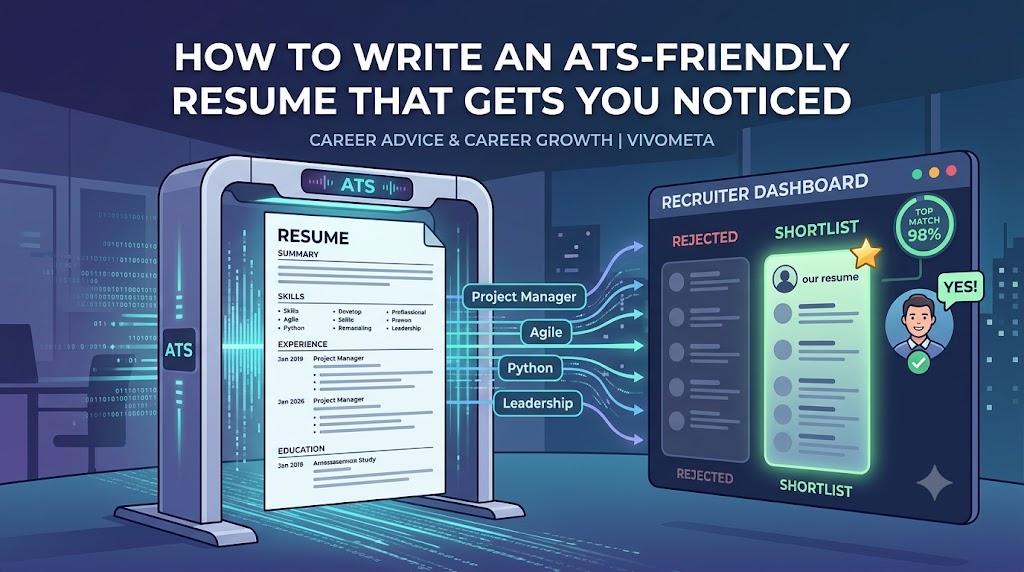
Over 85% of Fortune 500 companies now use some form of AI-powered screening in their hiring process. That number is not a projection—it is today's reality. Artificial intelligence is no longer a futuristic buzzword in recruitment. It is the first set of eyes, or rather algorithms, that scans your resume long before a human recruiter even knows you exist. If your resume is not designed to get past these intelligent filters, you are invisible.
But here's what most people miss: beating AI screening does not mean tricking a robot. It means building a resume that speaks the same language the AI has been trained to recognize, while remaining compelling to the hiring manager who eventually reads it. With the right strategy and Vivometa's Resume Builder, you can create an AI-friendly resume that opens doors instead of closing them.
How AI Screening Actually Works
It Is More Than Simple Keyword Matching
Older Applicant Tracking Systems relied heavily on exact keyword matching. Today's AI-powered hiring systems use natural language processing (NLP), machine learning, and predictive analytics.
Modern AI understands context, infers skills from your work history, and evaluates how likely you are to succeed in a role based on patterns learned from previous successful candidates.
That means an effective AI-friendly resume isn't simply packed with keywords. It combines semantic relevance, clean formatting, measurable achievements, and a clear professional story.
What AI Screeners Actually Analyze
When you upload your resume, AI hiring systems commonly evaluate:
- Relevance Score – How closely your profile matches the position.
- Skill Extraction – Technical skills, soft skills, and inferred competencies.
- Career Timeline – Progression, tenure, and employment gaps.
- Achievement Indicators – Action verbs, measurable results, and impact.
- Formatting Quality – Whether your resume can be parsed correctly.
Weak performance in any of these areas can reduce your chances of reaching a recruiter, regardless of your qualifications.
Core Principles of an AI-Friendly Resume
1. Write for Semantic Understanding
Keyword stuffing no longer works. Modern AI favors natural language that demonstrates how skills were actually applied.
Instead of simply listing Data Analysis in your skills section, write achievement-focused bullets like:
Performed data analysis on customer churn data, identifying three key drivers that reduced attrition by 14%.
This gives AI both the skill and the context in which it was used.
2. Prioritize Clear Structure
AI parses resumes sequentially, making organization extremely important.
- Use a single-column layout.
- Use standard section headings.
- Avoid text boxes, graphics, sidebars, and icons.
- Keep formatting simple and consistent.
Vivometa's Resume Builder automatically follows these best practices.
3. Quantify Your Achievements
AI systems recognize measurable success.
Weak Example
Managed a sales team.
Better Example
Managed a 12-person sales team and increased quarterly revenue by 22% within six months.
Numbers provide stronger evidence of performance than generic responsibilities.
4. Keep Formatting Parseable
Use standard fonts such as Arial or Calibri at 10–12pt. Save your resume as a .docx file unless the employer specifically requests PDF.
A simple way to test your resume is to copy it into Notepad. If everything appears in the correct order, it will likely parse correctly.
How to Build an AI-Friendly Resume Step by Step
Step 1: Analyze the Job Description
Identify:
- Primary hard skills
- Secondary skills
- Repeated keywords
- Desired outcomes
- Soft skills mentioned throughout the posting
The wording used throughout the job description provides valuable clues about what the AI expects to find.
Step 2: Tailor Your Resume
Generic resumes rarely perform well. Maintain a master resume and customize a copy for every application.
- Update your summary.
- Reorder skills based on relevance.
- Swap in more relevant accomplishments.
- Mirror important terminology naturally.
Step 3: Write Better Bullet Points
Every bullet should answer three questions:
- What did you do?
- How did you do it?
- What was the measurable result?
Example:
Redesigned the onboarding program using employee feedback loops, reducing ramp-up time by 30% while increasing new hire satisfaction scores to 4.8 out of 5.
This single sentence demonstrates leadership, process improvement, communication, and measurable success.
Step 4: Test Your Resume with AI
Before submitting your application, compare your resume against the target job description using an AI resume review tool.
Aim for a match score above 80%, then revise and test again until your resume aligns with the role.
Case Study: Miguel's Career Turnaround
Miguel, a supply chain analyst with six years of experience, submitted 25 applications for logistics manager positions without receiving interviews.
An AI screening analysis revealed several issues:
- Two-column resume design
- Important skills hidden in a sidebar
- Generic, task-focused bullet points
- Low AI match score of approximately 45%
His resume was completely redesigned using a single-column format, stronger action language, and measurable accomplishments.
Before
Managed warehouse inventory.
After
Managed $4.2M in warehouse inventory while implementing a cycle-counting program that reduced inventory discrepancies by 61%.
Using Vivometa's Resume Builder ensured the formatting was AI-compatible.
Three weeks later, Miguel received five interview invitations, with AI match scores improving into the mid-80% range.
Quick AI Resume Checklist
- Use a single-column layout.
- Avoid images, icons, tables, and sidebars.
- Use standard section headings.
- Blend keywords naturally into achievement-based bullet points.
- Quantify accomplishments whenever possible.
- Spell out acronyms once before using abbreviations.
- Save your resume as DOCX unless PDF is requested.
- Run an AI resume review before applying.
Where Vivometa Fits Into Your AI-Ready Job Search
You can certainly implement every recommendation manually. However, today's hiring process moves quickly, and Vivometa's Resume Builder is designed specifically for modern AI screening systems.
Features include:
- AI-friendly templates
- Standardized headings
- Single-column layouts
- Achievement-focused writing suggestions
- Multiple resume versions
- DOCX and PDF downloads
- Clean, parseable formatting
The builder helps you spend less time worrying about formatting and more time showcasing your experience effectively.
Conclusion
AI-powered hiring is becoming the standard across industries. Fortunately, the qualities AI rewards—clarity, relevance, measurable results, and logical structure—also create stronger resumes for human recruiters.
Start with one job description, tailor your resume, quantify your achievements, and test it before applying. Small improvements can produce significantly better interview rates.
When you're ready to simplify the process, let Vivometa's Resume Builder handle the formatting while you focus on telling your professional story. Your qualifications deserve to be seen—and AI should recognize them too.
The Vivometa Editorial Team